
Ethelo Process Stage 2: Voting

Once the ideation process is complete and the issues, options, and constraints are set, it’s time to start voting.
- See Ideation Overview for more information about Stage 1
What comes to mind when you think about voting? For many of us, it’s cramming into a small booth by yourself to fulfill your role as a member of democratic society by checking off a few boxes in total secrecy from your fellow community members. Oh, and you need to do all of this in person, potentially encountering long lines in the process.
Ethelo disrupts the entire voting process by allowing voting to be done online in a very detailed and – if the participant wants – open way. Participants can vote directly on issues ("direct voting"), or choose other participants they trust to vote on their behalf ("trust voting"). They can keep their vote private, or share it with others.
Direct Voting
Applying Criteria
Each participant votes by evaluating some or all of the various options. The default way to evaluate an option is to choose a point on the spectrum between “total oppose” and “total support,” but you are by no means limited to those options.
One of Ethelo’s unique features is that each participant can identify their own set of criteria or objectives that they wish to apply in evaluating the options. Those criteria can change across options and issues and do not need to be shared with other voters.
Returning to the new school example one more time, voters might choose one set of criteria for evaluating the features of a new school and another set of criteria for evaluating its location.

An example of a single criteria evaluation
A user evaluates each option by assessing, in their opinion, how well the options stand under the application of the various criteria, on a scale of -100 to 100. In this system, “-100” means that the option falls on the negative side of the criteria, “0” means it is neutral, and “100” means the option falls on the positive side of the criteria.
Users can choose this value in a variety of ways — a sliding scale, direct entry, or buttons corresponding to different values, just to name a few. The criteria and voting tool might be different from option to option. For example, one question might be best suited for criteria ranging from “Strongly Disagree” to “Strongly Agree” while “Very Expensive” to “Very Inexpensive” work well for another.
The result is a series of ratings for each option referred to in Ethelo as the preliminary score for the options. It would be easy to end voting there and move on to aggregation, but Ethelo takes things one step further to fully harness the power of the democratic process.
Assigning Weight
Ethelo also allows users to weigh in on how important different criteria and issues are to them. Recall that “issues” are groups of options, a quite different idea than “criteria” which are metrics of evaluation. However, both can have weights.
Each participant can assign a weight to each issue or criterion on a scale of 0-100. This weight will be used, along with the preliminary score, to generate an overall score for each option. Users can also assign a weight to each issue, on a scale of 0-100 indicating the importance of that Issue to them.
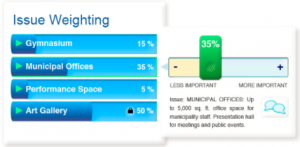
An example of issue weighting
So, not only are users deciding how they feel about a given issue, they are also deciding how important that issue and its criteria are in the grand scheme of the decision. This provides participants with an unparalleled level of granularity in expressing their preferences between different scenarios.
How all these different components interact may sound complicated on paper, but the process is seamless for users. They navigate Ethelo just as they would any other online survey or feedback tool. The calculations take place behind the scenes in real-time so a user can see how his or her score changes based on how they weight issues and evaluate options.
Trust Voting
This feature is not yet implemented on Ethelo. However, soon participants will be able to also vote “indirectly,” using Trust Networks (see Trust Networks article). Trust networks are an implementation of Liquid Democracy, where participants can delegate influence to other participants based on those persons' knowledge and/or influence in a particular area.
Dynamic Feedback
One of the strengths of the Ethelo platform is that it is able to give dynamic feedback to a participant, using the vote data they provided to identify the scenario that they would be most likely to support. In order to do this, it processes the vote data along with the options and constraints, to identify a specific combination of options that participant would give the strongest support. This is calculation is covered in more detail in Results.
Learn More
You can learn more about the Ethelo voting process by reading Ethelo Voting - Deep Dive.
Next Up: Results
After the votes are cast and the scores tallied, Ethelo’s algorithm analyzes the data across all the participants to identify the best decisions The final post in this series will dive into the algorithm to show how Ethelo analyzes votes, trust, and criteria to generate the most popular outcome for any decision.